


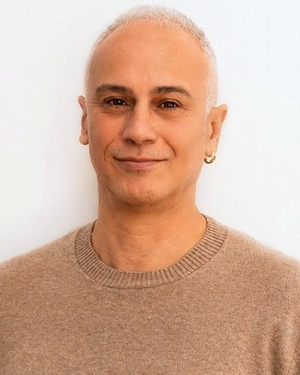
Uri Bookman
Relationship Therapist, Counsellor
Burringbar, NSW 2483
In Person + Online Therapy Australia-wide
Philosophy & Vision
You may function well on the outside yet find yourself caught in recurring patterns, in relationships, within yourself, or when anxiety or overwhelm takes over.
I’m Uri Bookman, a PACFA Registered Clinical Counsellor (30041) and relationship therapist. I work with individuals and couples who want to understand what is happening beneath the surface and respond differently.
My approach is warm, direct and collaborative, drawing on trauma-informed psychotherapy, Processwork, attachment, IFS and EFT. Together, we develop greater awareness, choice and connection where it matters.
Background
My background spans more than a decade of counselling, coaching, group facilitation and personal development work. I’m a PACFA Registered Clinical Counsellor (30041) with a Graduate Diploma in Trauma-Informed Processwork Psychotherapy.
Before private practice, I worked in business and technology, giving me firsthand understanding of professional pressure, leadership and major life transitions. I have also facilitated men’s work and trained therapeutic coaches.
My ongoing clinical development includes Processwork, attachment, IFS, EFT and Nonviolent Communication.
Services
I offer trauma-informed counselling and psychotherapy for individuals and couples, online Australia-wide and in person near Byron Bay. My work is particularly suited to relationship difficulties, recurring emotional patterns, anxiety, infidelity and men’s issues.
I also offer couples intensives, mediation and co-parenting support, therapeutic coaching, and men’s work. A limited number of reduced-fee places are available.
Quality Provision
I offer warm, direct and collaborative therapy with clear goals and honest communication about how the work is progressing. Sessions are tailored to you rather than following a fixed formula, while remaining grounded in professional ethics, ongoing clinical development and supervision. If I’m not the right practitioner for your needs, I’ll be transparent about that.
Areas of Interest
Accreditations
- Graduate Diploma in Trauma-Informed Processwork - 2023 - Pathways Psychology Institute
Modalities
Attachment Theory - Emotionally Focused Therapy - Experiential - Inner Child - Integrative - Internal Family Systems - Jungian - Process Oriented - Somatic Psychotherapy - Trauma-Informed
Therapy Approach
My approach is relational, trauma-informed and integrative. Rather than focusing only on the presenting problem, we explore the patterns, triggers, and underlying dynamics that shape what happens in real time.
I draw on Process-Oriented Psychology (Processwork), IFS, EFT, experiential and somatic approaches, inner-child and shadow work, and Nonviolent Communication. This allows us to work with thoughts and emotions as well as what happens in the body and in relationships.
The aim is not simply insight or symptom relief, but greater awareness and choice — so you can respond differently when it matters. My style is warm, direct and collaborative, combining depth with practical change.
Professional Associations
- Psychotherapy and Counselling Federation of Australia
Practice Locations
43-45 Broadway
Burringbar NSW 2483
Ample parking is available.
Appointments
Available Monday, Tuesday, Thursday and Friday, with limited Saturday appointments. Sessions are available online Australia-wide and in person near Byron Bay.
Fees & Insurance
Individual sessions are $200 and couples sessions are $300. I offer a free 15-minute initial consultation. Private health fund rebates may be available depending on your insurer and level of cover. A limited number of reduced-fee places are available
Languages
English
Hebrew
Payment Options
Payment is available by credit or debit card and bank transfer.
Contact Uri
Please contact me to book a 15 minute free initial consult
A conversation with Uri Bookman
-
My interest in healing and personal development began in the 1990s, though my career initially led me into business. After founding and running an IT company, I found myself increasingly drawn back to work that felt more meaningful.
I trained extensively in psychotherapy and counselling and eventually made this my primary work. What continues to engage me is helping people understand the patterns that shape their lives and relationships, and seeing what becomes possible when greater awareness creates genuine choice. -
Buddhist psychology, Taoism and earth-centred perspectives have strongly influenced how I understand change. They share an emphasis on awareness, relationship and working with experience rather than constantly fighting against it.
These influences complement my psychotherapy training and contribute to a therapeutic stance that is grounded, curious and compassionate, while still making room for responsibility and practical change. -
I’m particularly interested in the patterns we carry into relationships — how earlier experiences, protective responses and beliefs continue to shape what happens in the present.
I’m also interested in the tension between acceptance and change: learning to meet ourselves more compassionately without using compassion to avoid responsibility. Much of my work ultimately comes back to helping people live and relate with greater awareness, authenticity and choice. -
My work is integrative and trauma-informed, drawing primarily on Process-Oriented Psychology (Processwork), attachment-based work, IFS, EFT, experiential and somatic approaches, Jungian and shadow work, and Nonviolent Communication.
I don’t apply these as a fixed formula. We use what is relevant to understand the patterns, emotions, bodily responses, and relationship dynamics occurring in your life — and to develop a greater capacity to respond differently. -
Some people experience greater clarity or relief within the first few sessions; deeper patterns usually take longer to change. I don’t think there is an honest timetable that applies to everyone.
Early on, we’ll clarify what you want to change and pay attention to whether the work is actually helping. Progress might mean fewer recurring conflicts, recognising a trigger before reacting, recovering more quickly when things go wrong, or having greater freedom to respond differently. -
Personal therapy has helped me understand my own patterns, face parts of myself I might once have avoided, and become more compassionate without becoming less accountable.
It has also taught me that this work is never really “finished.” I continue to learn through personal reflection, supervision and ongoing development. That matters to me because I don’t ask clients to go anywhere I wouldn't explore myself. -
I value the moment when something that has felt confusing or stuck begins to make sense, when a person sees a pattern differently, a couple finally hears each other, or someone discovers they have more choice than they realised.
I also value the trust involved. People bring very real parts of their lives into therapy, and being invited into that process is something I don’t take lightly. -
Of course. I have difficult days, get things wrong and experience the same range of emotions as anyone else.
What has changed through my own therapeutic work is my relationship with those experiences. I’m less interested in getting rid of an uncomfortable feeling and more interested in understanding what it might be telling me. And yes, sometimes a bad day is simply a bad day. -
Disconnection — from ourselves, from one another and from the communities and natural world we belong to.
When we lose that sense of connection, fear and division become easier. I don’t imagine therapy solves the world’s problems, but I do believe that people who understand themselves better, take responsibility for their impact and learn to relate across differences contribute to something larger than their own healing. -
Siddhartha by Hermann Hesse has stayed with me for many years — particularly its exploration of finding wisdom through lived experience rather than simply adopting someone else’s answers.
And, from a very different shelf, The Matrix. Its questions about reality, conditioning and choice still resonate with me. Apparently existential philosophy and science fiction make good companions.